
Two quotations headed "panoramic padel court" can cover different structures, turf packages and installation support. A lower equipment price may still suit your project, provided you know which work and costs sit outside it. Use the comparison below to find those differences before choosing a supplier.
Start with one project brief
Send the same brief to every supplier. Include the country and city, court count, intended use, indoor or outdoor setting, canopy plans and target opening date. Add a site plan with available space, vehicle access and the position of existing buildings. State who will handle local design, foundations, drainage and installation, even if those appointments are still pending.
FIP specifies a doubles court measuring 20 × 10 m internally. That rectangle is the playing enclosure; it does not define the full site, foundation outline or canopy footprint. Leave the surrounding layout for the project team to coordinate. FIP Rules of Padel, "The court: Dimensions".
Tell suppliers about conditions that could change their proposal. Coastal exposure raises questions about the finish and maintenance plan. A roof introduces its own supports, clearance and drainage interfaces. A venue intended for competition needs the relevant event requirements identified early. For several courts, explain whether construction and opening will happen together or in phases.
If a supplier changes an assumption, ask them to mark it. A proposal for an uncovered recreational court cannot be compared directly with a covered venue package until the difference is visible.
Find out who controls the drawings and components
Ask the supplier to describe the route from approved drawings to packed equipment. Which operations are carried out in its factory? Which components come from specialist manufacturers? Who approves substitutions and updates the component schedule?
Bought-in glass, turf or luminaires can be part of a coordinated package. Ask who keeps those components compatible with the selected enclosure and who will explain any change. Apply the same questions to manufacturers, distributors and project integrators.
Request a model-specific drawing sample, a component list and an example of the proposed packing identification. Check that the supplier can connect a part reference to the drawing revision and explain how you would order a replacement later. A factory video can help you understand the operation; these records show how your order would be defined.
When discussing previous projects, ask what the company actually supplied and who installed it. A photograph alone leaves those responsibilities unclear. Use references that the supplier is authorised to share and that resemble your project's environment or delivery arrangement.
Compare the configuration row by row
Create a column for each supplier beside this checklist. Record the proposed specification, any departure from your brief and the answer still needed. PadelSpan's court specifications provide a starting point for its available supply configurations; the selected order needs its own agreed schedule.
Swipe to see all columns
| Item | Ask each supplier to identify | Why the difference matters |
|---|---|---|
| Frame and enclosure | Model, material grade, section sizes, wall thicknesses, mesh and drawing revision | A family name such as panoramic does not define the complete structure or its site suitability. |
| Protective finish | Treatment sequence, finish specification, treatment of cut or welded areas and agreed inspection method | A colour match does not describe corrosion protection. Compare the proposal against the actual exposure. |
| Glass and fittings | Glass type, panel dimensions, thickness, holes, edges and compatible fittings | Matching thickness alone does not establish an interchangeable panel. |
| Turf package | Exact product, backing, installation requirements, infill and included consumables | A turf roll, a complete laying package and installed surfacing have different scopes. |
| Lighting | Fixture model, quantity, rated power, optics, mounting positions and design information | Wattage and pole count cannot establish illumination across the playing area. |
| Packing and transport | Package list, protection, delivery point and who arranges onward handling | Site access and unloading can create work outside the equipment price. |
| Installation and support | Assembly information, remote guidance, site labour, equipment and electrical scope | The phrase "installation support" needs a written description. |
| Parts and warranty | Replacement-part references, claim process, coverage and exclusions | You need to know how a damaged or worn component would be identified and replaced. |
For each row, use one of three notes: Cleared when the answer matches the brief, Clarify when something is missing, or Does not fit when the proposal conflicts with a confirmed project requirement. Avoid averaging an unresolved foundation interface into a good overall supplier score.
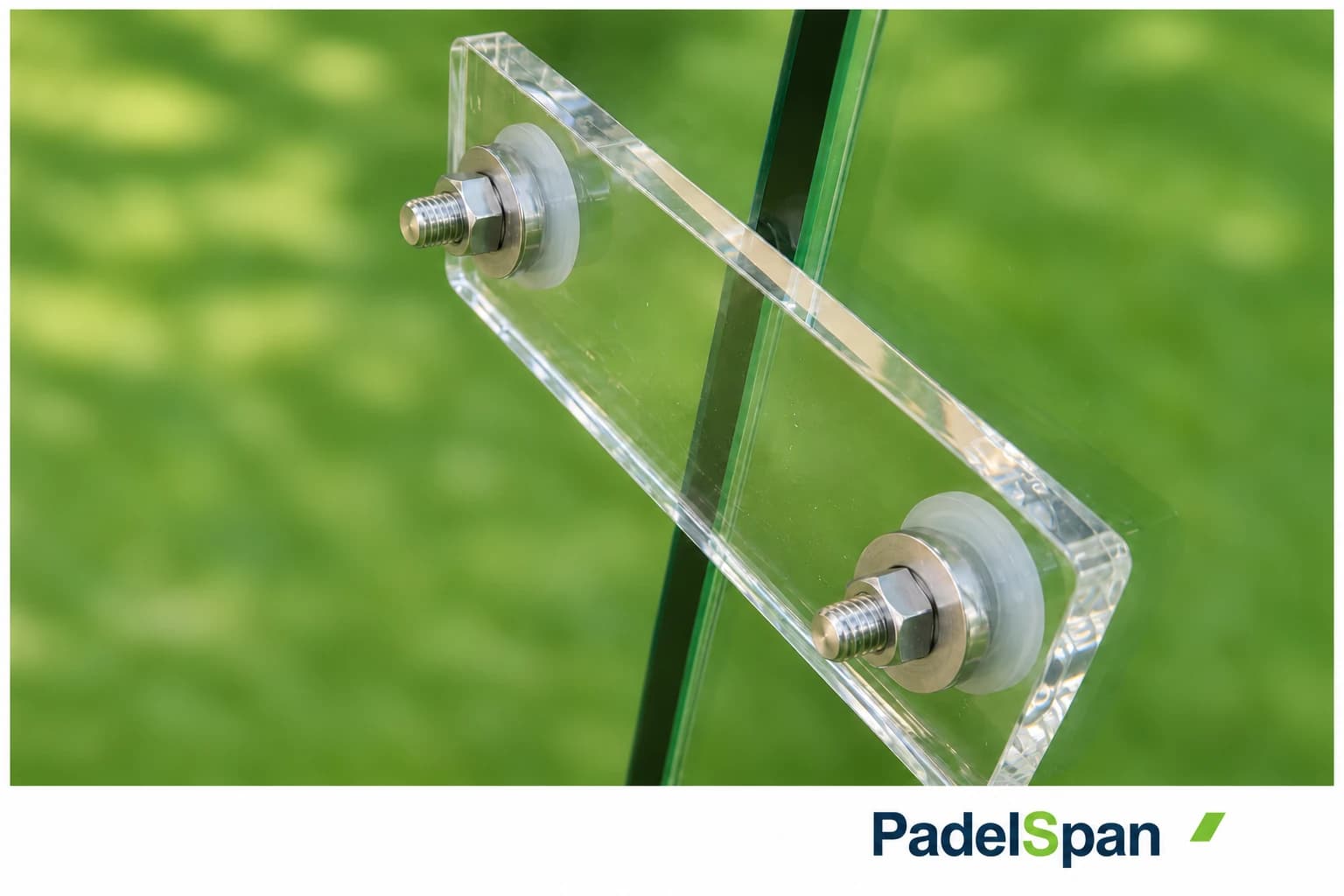
Consider two quotes that both list 12 mm glass. One identifies the panel sizes, hole pattern and fitting set; the other gives only the thickness. The second quote needs clarification before you can compare its glass package or plan spare panels. This is a comparison example, not a claim that thicker glass or one particular fixing suits every project.
For the full equipment-versus-site breakdown, use the separate guide to what is included in a padel court quote. Keep the supplier comparison focused on differences that change your decision.
Read each document within its scope
Match each document to its subject: a component, a model, a declared characteristic or a particular project design. Keep the holder or issuer, product reference, applicable scope and document revision visible when comparing proposals.
FIP playing rules, a turf approval, a glass document and a local structural calculation answer different questions. Identify which question each document actually resolves.
Swipe to see all columns
| Document or claim | What to match to the proposal | Boundary to retain |
|---|---|---|
| FIP playing rules | Court layout and the requirements relevant to intended play | A rules reference alone does not establish tournament appointment or approval of a factory. |
| FEP turf information | Named manufacturer, product and model | Do not extend a particular turf approval to the frame or the whole court. |
| CE-related component documents | Identified product and the applicable declaration or supporting document | A component document does not automatically cover the entire installed venue. |
| LED EMC documents | The luminaire and model covered by the information | Electromagnetic compatibility does not state the court's lux level or uniformity. |
| Structural and execution requirements | The structure, site inputs, applicable requirements and responsible designer | Agree these for the project; do not infer them from an unrelated component certificate. |
The European Commission explains CE marking as a manufacturer's declaration about a product's conformity with the applicable requirements. It is not an EU authority's approval of the product as safe. European Commission: CE marking. The FEP's public list identifies approved materials by company and model, which is why the exact turf reference matters. FEP: companies and approved materials.
PadelSpan supports glass CE, turf FEP and LED EMC documentation for the relevant supplied components. Review the applicable scope through the component documentation overview. These component records do not establish whole-court certification, EN 1090 certification or FIP event appointment.
Compare lighting by its design, as well as its rated power
PadelSpan retains an 8 × 200 W option and offers a 4 × 400 W option. Their listed rated powers add up as follows.
Swipe to see all columns
| Lighting option | Calculation | Total rated power |
|---|---|---|
| Eight 200 W fixtures | 8 × 200 W | 1,600 W |
| Four 400 W fixtures | 4 × 400 W | 1,600 W |
This arithmetic compares the sum of the listed fixture ratings. It does not demonstrate equal lux, uniformity, glare control or measured electricity consumption. Nor does it establish that the two options can be exchanged on an unchanged court structure.
Ask for the fixture reference and a lighting layout showing positions, mounting heights, aiming and the intended performance criteria. A designer can then assess the selected fittings for the venue and specify how the installed result will be checked. The LTA's UK guidance treats illumination, uniformity and fitting angles as design information, illustrating why a wattage total cannot answer the whole question. LTA construction guidance, "Floodlighting".
Compare access for future maintenance too. Fixture quantity changes the number of items to service, while mounting and access arrangements affect how that work can be done. An attractive night rendering is useful for appearance discussions; request design information for the lighting decision.
Agree the site interfaces before placing the order
The supply package must connect with the people preparing the site. Ask the local designer and installer to review the supplier's interface information while quotations are still being discussed. This is especially useful where a canopy, exposed location or existing slab affects the proposal.
For UK projects, the LTA guidance calls for a UK-qualified structural engineer to design the ring beam, sub-base and drainage with local loads considered. Other destinations need their own applicable design and approval route. LTA construction guidance, "Ring beam, sub-base construction & warranties".
Use this responsibility table as a discussion aid. The parties named in the eventual agreement may differ.
Swipe to see all columns
| Interface | Information to exchange | Agree who owns the next step |
|---|---|---|
| Enclosure to foundations | Selected layout, connection details and design information needed by the local designer | Site design, foundation construction, setting-out and acceptance |
| Shipment to installation | Packing list, package dimensions and weights, access and storage needs | Import arrangements, onward transport, unloading and safe handling |
| Lighting to site services | Selected fittings, layout and electrical information | Local electrical design, connection, installation and checks |
| Completed court to operation | Inspection list, operating information, maintenance and part references | Site acceptance, issue resolution and ongoing maintenance |
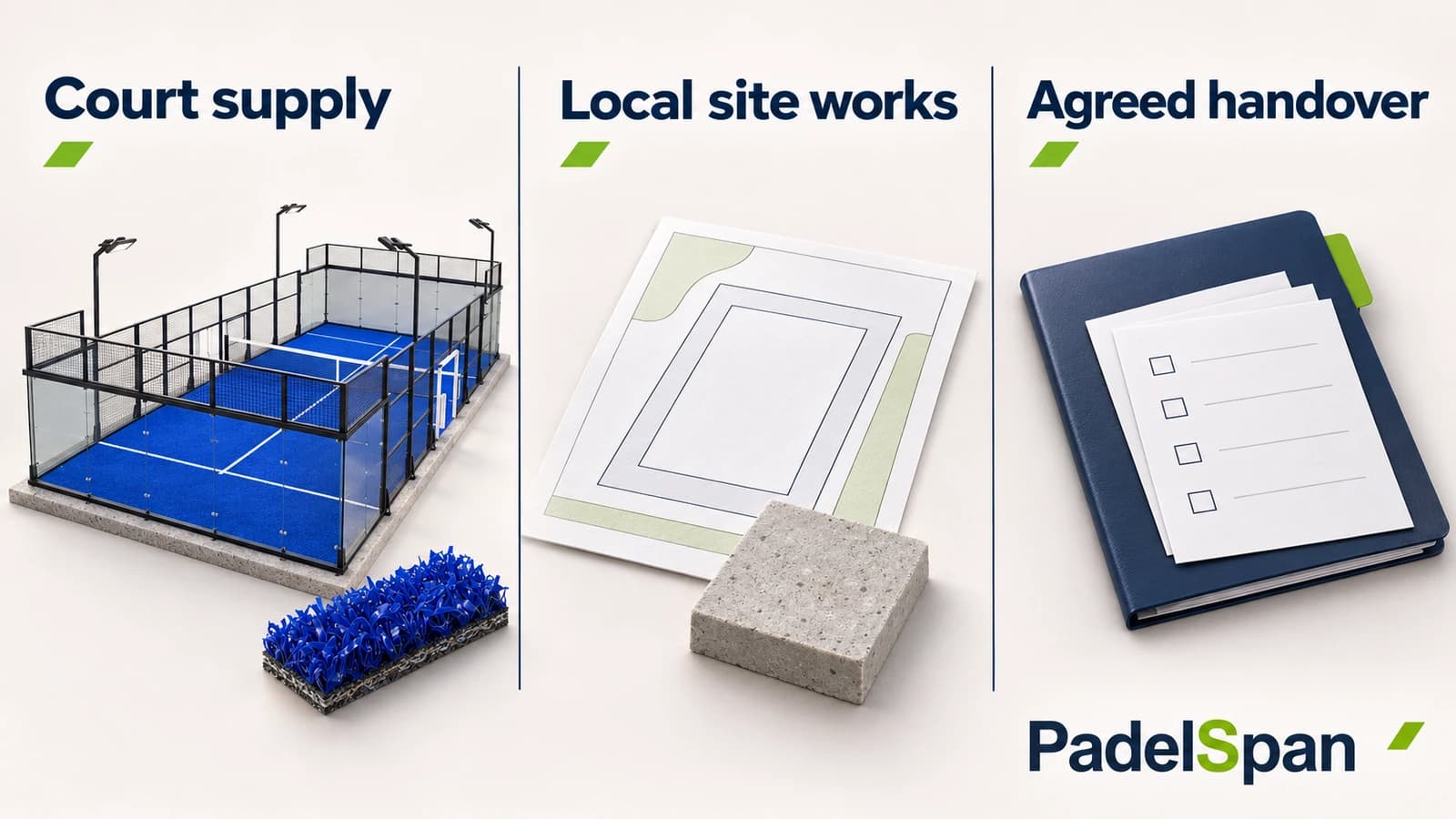
For the wider checklist, see installation planning and responsibilities and shipping, packaging and unloading. Bring any difficult delivery access into the quotation discussion, before the packing and transport plan is settled.
Separate production time from your opening date
PadelSpan's usual production period is 20 to 30 days, depending on quantity and customisation. This describes production. Shipping, customs clearance, local construction, installation and handover need separate allowances. Confirm what starts the production period and what must be approved first.
Fill in a simple programme with the selected supplier and site team. Some work may overlap, but an overlap should have an agreed dependency.
Swipe to see all columns
| Stage | Record before relying on the date | Your agreed date |
|---|---|---|
| Configuration and drawing approval | Outstanding decisions and who signs them off | To agree |
| Production | Start condition, duration and any order changes | To agree |
| Packing and dispatch | Release information and planned shipment | To agree |
| Transport and import | Delivery point, route assumptions and import responsibilities | To agree |
| Site readiness and installation | Foundation acceptance, access, labour and equipment | To agree |
| Handover and opening | Checks, remaining issues and operating readiness | To agree |
When a change affects drawings or bought-in components, request the revised schedule alongside the revised price. Compare suppliers on dates they can explain and the assumptions behind them.
Use a short checklist before you order
- Every supplier has answered the same project brief, with departures identified.
- The selected model and drawing revision match the component schedule.
- Glass, turf and lighting have specific references, with inclusions and exclusions recorded.
- The documentation applies to the proposed components and intended project.
- Local design, foundations, drainage, installation and electrical responsibilities have named owners.
- Transport, unloading, warranty exclusions and replacement-part arrangements are understood.
- Production and site milestones have been separated from the target opening date.
Keep the supplier's written answers beside the quotation, and assign an owner to each unresolved item. If a confirmed site requirement cannot be met, resolve the design or supply choice before committing to the order.
Prepare a comparable PadelSpan proposal
PadelSpan is a padel court manufacturer in Hebei, China. Its manufacturing operation coordinates steel fabrication, protective finishing, selected court components and export packing. Custom orders can start with one court. Panoramic padel courts, other court configurations and canopy options should be discussed against the same site brief.
Send the location, court count, intended use, site plan, canopy needs and target date. Include the local contractor's contact role and any required documentation or delivery conditions. This gives the project team a basis for identifying the configuration and the questions that need local design input.
Practical answers
Frequently asked questions
Is buying directly from a factory always the better option?
Choose the arrangement that gives your project clear technical and commercial responsibility. A factory, distributor or integrator should explain who controls the drawings, coordinates components and handles support. Local installation capability and communication can matter alongside the equipment price.
Does a CE document mean the whole court is certified?
Read what the document covers. A record for glass or another component should be matched to that product and model. It cannot, by itself, establish approval of the foundations, canopy, complete venue or a particular competition.
Is 12 mm glass enough information to compare two offers?
No. You also need the glass type, dimensions, hole pattern, edge treatment and fitting arrangement for the selected model. The local project requirements remain relevant. Those details also help identify a replacement panel correctly.
Are 8 × 200 W and 4 × 400 W equally bright?
Both have a listed rated total of 1,600 W. Equal rated power does not establish equal illumination. Compare the selected fixtures and layout, the intended photometric results and the checks planned for the installed court.
Can I order one customised court from PadelSpan?
Yes. PadelSpan can supply a custom order starting with one court. Discuss the model, finishes, components and requested changes so the quotation and drawings describe the same configuration.
Does a 20 to 30 day production period include delivery and installation?
No. PadelSpan's usual 20 to 30 day period concerns production and varies with order quantity and customisation. Confirm its start conditions separately from shipping, customs clearance, site works, installation and opening.
Further reference
Sources & scope
- FIP Rules of Padel, "The court: Dimensions"
- European Commission: CE marking
- FEP: companies and approved materials
- LTA construction guidance, "Floodlighting"
Our technical team translates your site layout, equipment choices and local construction requirements into a coordinated manufacturing and delivery brief.
