
The four-court example below shows how occupancy changes cash surplus and simple payback, with everyday costs and replacement reserves listed separately. Every euro in the example is a modelling assumption, not a European market average, PadelSpan quotation or promised return.
Start with the venue budget, then allocate costs per court
A court added to an existing tennis club may share reception, parking and utilities. A new standalone venue must fund those functions itself. Comparing their headline annual cost per court without those differences can conceal the largest bills.
Build the whole-venue budget first, separating direct court costs from shared bills. Allocate shared rent by occupied space where appropriate, staff by the work they perform, and utilities by metering or a documented estimate. Dividing everything equally by court count gives a starting comparison; it does not show what each court actually consumes.
Keep four amounts separate: initial project investment, recurring operating payments, replacement reserves and financing payments. The court quotation scope guide helps identify supply and project exclusions. This article focuses on what happens after opening.
What belongs in an operating-cost budget?
Include owner labour even if the owner initially takes no salary. Otherwise, an apparently profitable self-service venue may depend on unpaid management, cleaning and customer support.
Swipe to see all columns
| Cost group | What to include | Evidence to collect |
|---|---|---|
| Premises | Rent, service charges, applicable property taxes and site obligations | Lease, landlord schedule and local bills |
| People | Reception, management, cleaning, employer costs and cover | Staffing rota and local employment costs |
| Energy and utilities | Lighting, building services, water and standing charges | Equipment schedule, tariff and meter readings |
| Routine care | Brushing, cleaning, inspections, consumables and minor repairs | Product instructions and service quotations |
| Software and transactions | Fixed subscriptions, payment processing and fees borne by the club | Signed provider terms and settlement statements |
| Insurance and administration | Suitable cover, accounts, permits and communications | Local quotations and renewal dates |
| Customer acquisition | Marketing, events and introductory offers | Spending plan with booking targets |
| Replacement reserve | Future major work, accounted for separately from routine care | Installed replacement quotations and planning scenarios |
Do not assume a universal booking-platform deduction. A booking provider’s published player-facing fee guidance says charges vary by country and currency; its legal terms also describe circumstances where the club absorbs the player service fee. Neither establishes a standard percentage of revenue paid by every club. Check your subscription, payment and booking terms separately. Published service-fee guidance, Provider payment conditions.
Keep fixed software subscriptions separate from transaction deductions. Record whether each fee is based on the customer's tax-inclusive payment, the club's net revenue, a fixed amount per transaction or some combination. Applying one assumed percentage to everything can double-count fees.
Use paid court-hours and a realised price
A full-looking evening schedule does not describe the whole trading week. Record available court-hours by month, then split paid bookings into peak, off-peak, coaching and other uses. Exclude planned closures from availability and avoid counting a coached session again as ordinary court hire.
Check the unit before importing a competitor's price. One UK sports club’s published non-member rules, updated 1 February 2026, list £28 peak and £24 off-peak for a 75-minute court booking, including lights. Those are neither hourly prices nor per-player prices. They demonstrate why booking duration and inclusions matter; they are not a market benchmark. Published club booking rules.
For your model, use realised court-hire revenue after discounts and refunds, excluding VAT where that tax treatment applies, divided by paid court-hours. Memberships need explicit treatment: either allocate relevant membership revenue to court use or keep it as a separate revenue line without counting it twice.
Keep the budget in one currency and ask your accountant which taxes are recoverable. Compare revenue and costs on the same tax basis: a VAT-inclusive customer price overstates revenue in a VAT-exclusive budget.
A worked four-court operating budget
The following is a hypothetical venue with four courts. It assumes 14 available hours per court per day across 350 days: 19,600 available court-hours a year. The average realised price is €32 per paid court-hour, excluding VAT. None of these assumptions describes a named club or a PadelSpan customer.
Swipe to see all columns
| Annual fixed-cost assumption | Four-court venue |
|---|---|
| Rent and premises charges | €60,000 |
| Staffing, including employer costs | €48,000 |
| Utilities and standing charges | €12,000 |
| Routine maintenance and cleaning supplies | €8,000 |
| Insurance, licences and professional costs | €8,000 |
| Marketing | €10,000 |
| Administration and fixed software subscriptions | €4,000 |
| Total recurring fixed operating costs | €150,000 |
| Separately allocated replacement reserve | €10,000 |
| Annual fixed cash requirement including reserve | €160,000 |
For simplicity, additional variable charges borne by the venue are assumed to equal 10% of court-hire revenue. That is a modelling input covering variable transaction and service costs, not a claim about any platform's commission. The model holds staffing and utilities fixed across the scenarios; an actual budget should adjust them where demand changes those costs.
The figures exclude financing, corporation or income tax, depreciation, food-and-drink operations, coaching revenue and associated costs. All revenue and recoverable-cost figures are net of VAT. Treat non-recoverable taxes as costs in your own version. The reserve is cash earmarked for future work, not a claim that this amount is an accounting expense in the current year.
How occupancy changes break-even and payback
Calculate revenue first, then the cash left after costs and reserve:
- Annual court-hire revenue = available court-hours × paid occupancy × realised hourly price.
- Cash surplus after reserve = revenue × (1 − variable-cost rate) − fixed operating costs − replacement reserve.
- Simple payback = initial investment ÷ annual cash surplus, provided the surplus is positive and repeatable.
Under the assumptions above, each additional paid hour contributes €28.80 before fixed costs: €32 × 90%. Covering the €160,000 annual fixed requirement therefore needs about 5,556 paid hours, or 28.3% of available hours. This is cash break-even including the reserve, before financing and tax.
Swipe to see all columns
| Scenario | Lower occupancy | Middle occupancy | Higher occupancy |
|---|---|---|---|
| Paid occupancy | 25% | 40% | 55% |
| Paid court-hours | 4,900 | 7,840 | 10,780 |
| Court-hire revenue | €156,800 | €250,880 | €344,960 |
| Assumed variable charges | €15,680 | €25,088 | €34,496 |
| Cash surplus after €160,000 fixed requirement | −€18,880 | €65,792 | €150,464 |
| Simple payback on assumed €400,000 initial investment | No payback at this run rate | About 6.1 years | About 2.7 years |
The €400,000 initial investment is another hypothetical input. Define yours using the complete funded project: equipment, groundworks, installation, building or cover work, professional costs, pre-opening expenditure and opening working capital as applicable. A supply-only court price is not the same denominator.
These payback figures assume the same annual surplus from the start. They exclude ramp-up, financing, tax, inflation, discounting and residual value. They also assume the reserve adequately funds replacement work. A financing decision needs a dated cash-flow forecast with the actual replacement payments and reserve movements, without subtracting the same replacement cost twice.
At 40% occupancy, lowering the realised hourly price from €32 to €28 reduces annual surplus to €37,568 and stretches simple payback to about 10.6 years. Increasing annual rent by €20,000 instead reduces that scenario's surplus to €45,792 and extends payback to about 8.7 years. Small changes to commercial assumptions can matter more than a discount on court hardware.
Budget for maintenance and replacement separately
Daily care and major renewal have different cash patterns. A surface manufacturer’s maintenance guidance discusses debris removal, sand distribution, drainage and surface checks, seam condition and maintenance records. It also identifies material, weather exposure and use as factors in surface wear. Use the installed product's instructions to set your maintenance programme. Surface-maintenance guidance.
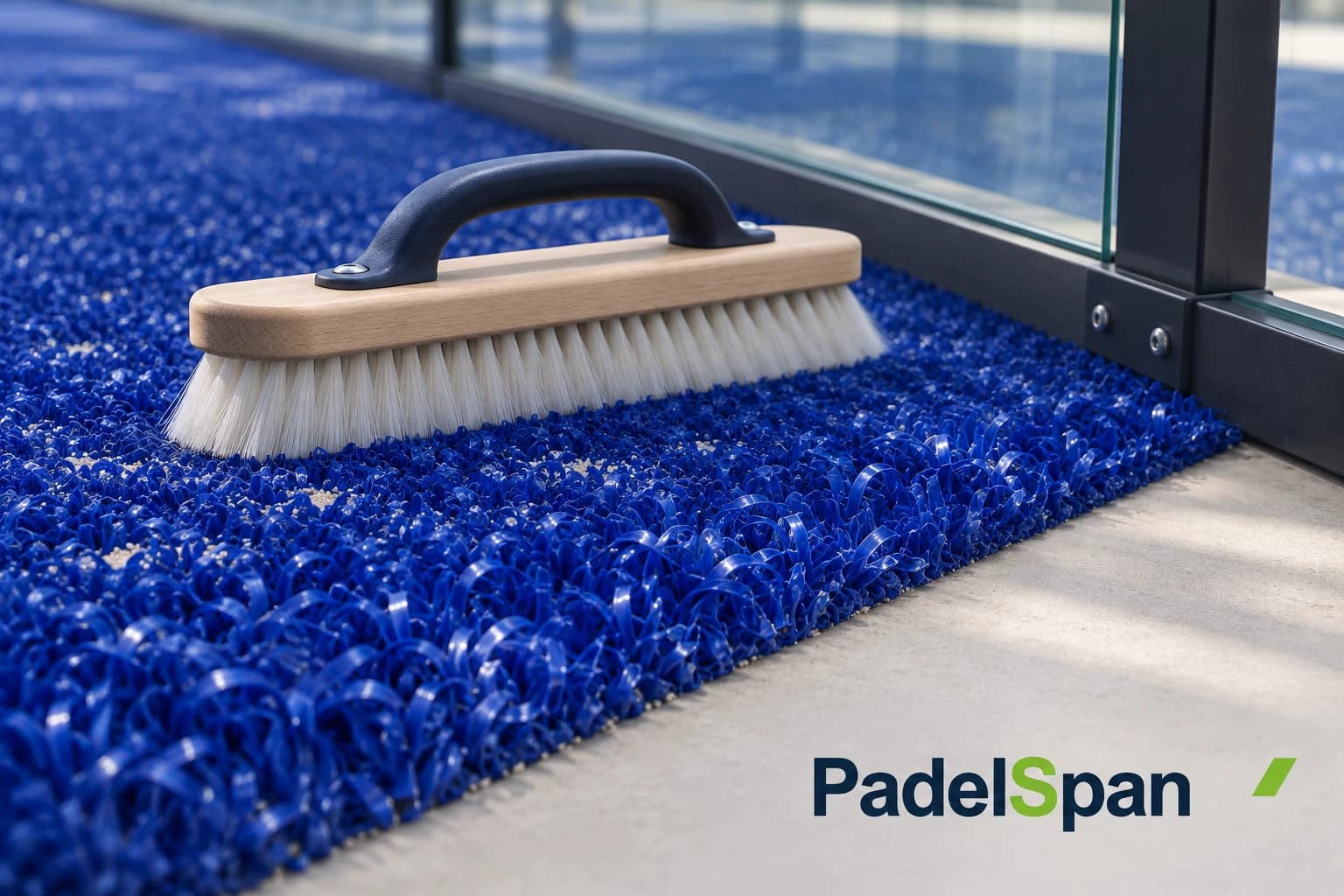
Ask for a replacement quotation that includes the material, removal, disposal, transport, installation, infill and anticipated closure. A carpet-only price misses costs you will still pay. Keep glass damage, lighting faults and structural repairs in separate risk and maintenance lines; they do not all follow the same replacement clock.
For example, suppose a complete future turf replacement is provisionally budgeted at €12,000 per court. Saving that amount over five years requires €2,400 a year; over eight years it requires €1,500. Both are arithmetic scenarios. Neither is a quoted replacement price, expected turf life or recommendation to keep a worn surface in use.
Update the reserve as quotations, condition reports and usage change. Warranty duration, expected working life and the chosen budgeting horizon are three different things. Ask what the warranty covers, what maintenance evidence it requires, and whether labour, freight and reinstallation are included. The PadelSpan turf page helps frame the product discussion; the actual offer and maintenance documents must establish project-specific terms.
Choose indoor, outdoor or covered courts against the budget
An outdoor court avoids some building costs, but its saleable hours depend on local conditions and permitted operating times. An indoor venue may offer a different booking pattern while bringing building rent, services and maintenance. A cover requires its own capital, maintenance and approval assumptions.
Model the proposed site month by month. Estimate recoverable booking hours from weather protection using local evidence, then compare their contribution with the extra annual costs and investment. Do not assume that adding a roof automatically raises occupancy or pays for itself.
For a full court-and-cover project, review covered padel court options. For a separate shelter scope, use the canopy page. Keep the two scopes distinct when requesting prices.
What to request before committing to the court package
Send PadelSpan the court count, site location, indoor or outdoor arrangement, intended operating hours and any proposed cover. Request the offer's exact equipment scope, lighting specification, turf choice, maintenance instructions, warranty terms and spare-part information. Ask which replacement materials and services are included or excluded.
Use those documents for the equipment and upkeep lines in your budget. Obtain local evidence for rent, staffing, utilities, insurance, taxation and demand. PadelSpan's quotation cannot establish your future occupancy or investment return.
Use the PadelSpan court calculator to explore your own inputs, with the clubs and investors page for the broader project discussion. Keep a dated copy of the assumptions behind any result.
Questions operators ask
How much does a padel court cost to operate each year?
Start with the venue's actual costs and separate shared overhead from direct court costs. An annual figure that excludes rent, paid management or replacement work cannot be compared fairly with one that includes them. The worked budget above demonstrates the method, not a typical European price range.
Can a padel club repay its investment in 24 months?
A two-year target needs annual cash surplus equal to half the defined initial investment, before any adjustments to that simple calculation. Whether a site can achieve it depends on its actual costs and revenue. A 2026 industry report presents an approximately three-year payback target for mature indoor racket-sport facilities within its established-market property analysis. That target is not a forecast for every new padel venue. 2026 industry report, page 51.
Is cash surplus the same as profit or cash available to the owner?
No. The worked surplus is before financing and tax and after an earmarked replacement reserve. Accounting profit treats items such as depreciation differently. Debt repayments, tax, working-capital needs and actual replacement spending affect what the owner can withdraw. Review those separately before treating the result as an investment decision.
Further reference
Sources & scope
- Published service-fee guidance
- Provider payment conditions
- Published club booking rules
- Surface-maintenance guidance
- 2026 industry report, page 51
Our technical team translates your site layout, equipment choices and local construction requirements into a coordinated manufacturing and delivery brief.
